

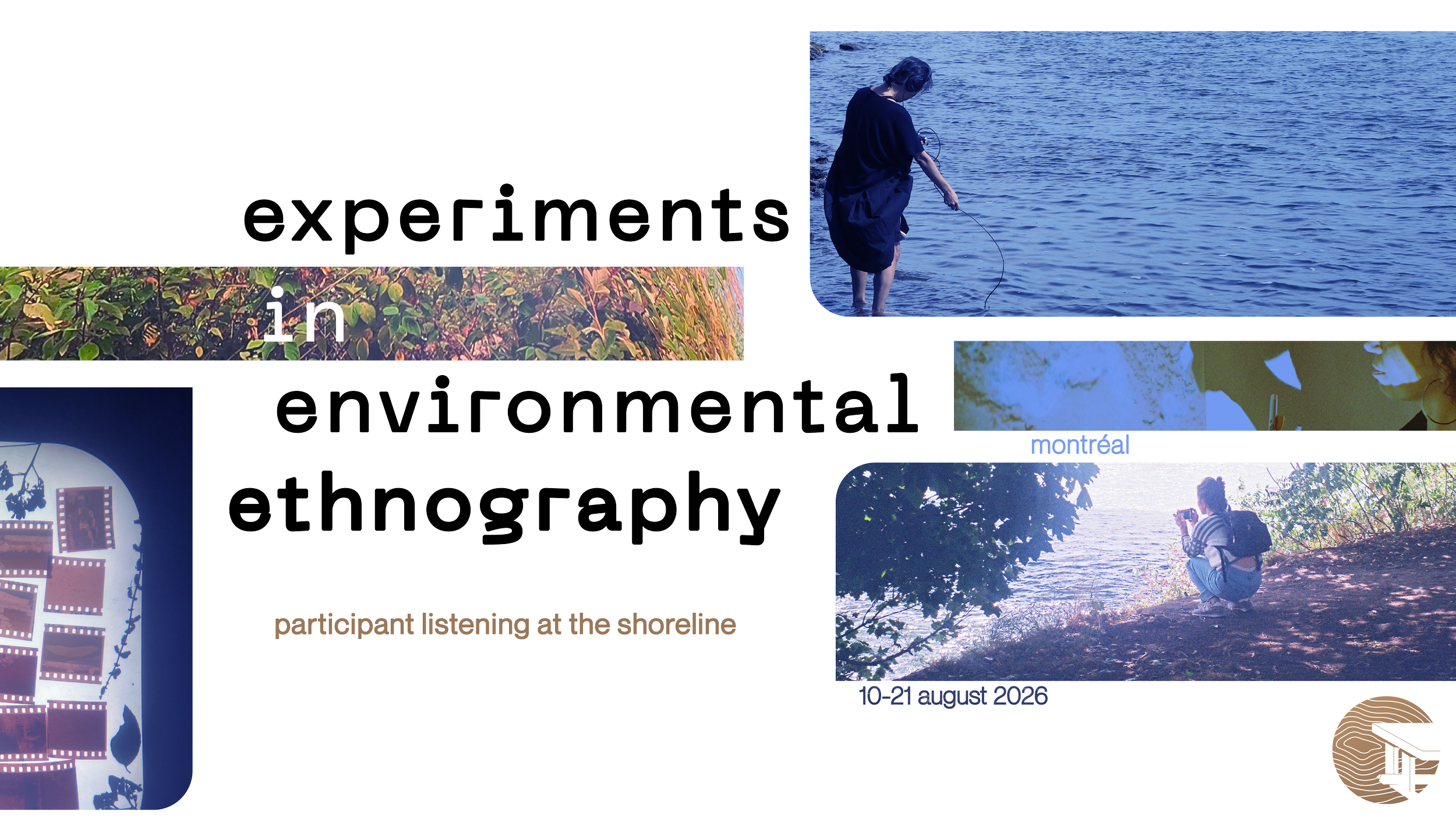
Experiments in Environmental Ethnography:
Participant Listening at the Shoreline
Graduate Summer Institute of the Concordia Ethnography Lab
August 10-21 2026
Summer Institute 2026
Ethnography has traditionally presented itself as a practice of “participant observation.” In this course we shift the sensory focus to “participant listening,” and ask how an aural engagement with the world differs from our more familiar visual engagements. Over two weeks of intensive theory and practice, students will experiment with new ways of sensing the socio-natural environment and build collaborative projects that foreground how sound shapes our experience of the world.
The course is partly classroom-based, and we will spend much of the first week reading, learning from experts and practicing various techniques of listening at the Concordia Ethnography Lab. The other part is field based. Taking the Verdun shoreline as our ethnographic object, students will work together to convey the environmental complexities of a place where land meets water, city meets river, and many species contend with histories of colonialism, industry and wonder.
The course is run in parallel with a similar course run by Heather Swanson and Knut Gunnar Nustad at the University of Oslo, and we will meet their group several times throughout the course as they work in parallel on Oslo’s Akerselva river.
The course includes an introductory grounding in anthropological theory and method, but is open to students with interdisciplinary backgrounds.
Instructor:
KREGG HETHERINGTON, with support from Patrizio McLelland and Polina Shubina.
Interventions from:
David Howes — Sensory Ethnography
Magali Babin — Listening to the Shoreline
Andrea Ballestero — Sensing the Underground
Nikhil Anand — The Anthroposea
Natalie Doonan — Eating the Urban Wild
Course Requirements:
Students do not have to have any specific ethnographic, artistic or recording experience to take the course, but any of these skills will be an asset. The course itself is intensive: students need to be present for all aspects of the course, read all required readings, and be prepared to work intensively on a collaborative group project. Graded components of the course include short online presentations, a personal reflection essay, a collaborative multimodal work-in-progress, and a final paper.
Supported by: