
Experiments in composite ethnography (III)
“Interdisciplinarity is hard”: Or, in service of investigating the mess
BY PATRIZIO MCLELLAND
This is the third in a five-part series of posts reflecting on the Graduate Summer Institute in Mess and Methods, which was hosted by the Waterways Collective in 2025. The Institute was an intensive training in collaborative, multimodal ethnographic methods that took Montreal's rivers, shorelines, and water infrastructure as its object of research.
The title for this piece came from a conversation held at the very end of the Summer Institute in 2025. Having collectively wrapped the frenzy of staging, presenting, and dismantling the in-process outcomes of collective and experimental ethnography, student participants gathered in the Speculative Life Research cluster. Here, among sunlight, concrete, couches, chairs, tables, food, and drink, Dr. Kregg Hetherington opened up an important conversation. By creating an opportunity for those involved to exhale and consider the rigours of the previous two weeks, he enabled a moment for important and reflective dialogue; what worked, and what didn’t work as well. These conversations—at times tense, at times heated, but always deeply attuned—marked a moment we are not often afforded: one of vulnerability. Challenging participants to think outside their discipline was central to the experiment of the Summer Institute; hence, this vulnerable moment was an important pathway into unpacking how challenging it actually was. What emerged was a collective suspicion: despite the centrality of interdisciplinarity in the contemporary academic research and creation it was, in fact, extremely clunky. Awkward. Hard.
While interdisciplinarity is often championed as a way to bridge chasms between faculty silos, the Summer Institute revealed that incompatibility (in methods, theory, or even the ways we communicate) is a significant barrier to entry. Incompatibility permeated the spaces between disciplines at the Summer Institute, and participants encountered it in myriad ways: tensions emerged across different scales, between different people, and in orbit around different objects.
For those of us who planned, supported, and facilitated this experimental learning, we saw tension arise especially between two specific groups: those who considered themselves social scientists (primarily anthropologists and sociologists) and those who considered themselves artists. We had intentionally put these groups together to generate an interdisciplinary exchange, in keeping with the larger mission of the Concordia Ethnography Lab. As the course came to a close, we began to reflect upon how the Summer Institute itself had served as a connective tissue between the faculties, coaxing the Artist out of the Anthropologists and vice versa. Initially, the artists would be keen to (literally and figuratively) put their feet in the water while the anthropologists would be more interested in observing the whole of the goings-on at the shoreline, curiosity would bring about an inevitable swapping of registers. What happens when the artist sits reflexively with their writing and observation, while the anthropologist uses microphones to listen to underwater soundscapes? These moments created unforeseen challenges for participants and, in the face of it, they rose to the occasion, generating experimental forms of collaborative investigation and making. Asking those involved to make themselves vulnerable by presenting those spontaneous moments within condensed and frenetic periods of fieldwork underpinned the tension (awkwardness, discomfort) that we observed as truly central to interdisciplinarity.
We already knew that collaborative work like this would be difficult. The Ethnography Lab had previously developed “composite ethnography” as a means to pluralize perspectives, generating “ethnographic artifacts that expressed their multiplicity in strange and exciting ways” (Campos et al., 2025). This demanded never losing sight of both the unity and fragmentary nature of collaborative work, in order to dually place emphasis on the object of research and the group of collaborators who came to meet it. In that spirit, we found it useful to link the tensions we encountered to those that occur between disciplines. Difficult as they were, frictions opened a broader conversation about how colliding perspectives can shape our experiences on and off- site.
Everyone arrived at the Summer Institute with their own experience, biases, skills and curiosities; they each brought a different idea of what they hoped to accomplish. Those ideas were developed through extensive readings, lectures, discussions, alongside a variety of workshops and field work; experiences which could appeal to theoretical grounding, palpable physical encounters with the shorelines, or both. Predicating the Summer Institute on the potentials of collaborative art-making, however, meant that an individual participant’s ideas would be subject to group dynamics. Misalignment between perspectives created contrasts and conflict, which emerged in plain sight.
The differences between social relations within groups demonstrated exactly that. At the shoreline, some groups almost instinctively elected to stay together in their fieldwork, while others immediately split off. Some ventured as far as they could from our initial meeting point; others stayed put. Fluctuations like this shouldn’t come as a surprise to anyone who has worked intensely in group settings. As with most collaborative dynamics, groups included participants who had the tendency to dominate conversations, and their forms of leadership (whether welcome or unsolicited) made it difficult for others to voice themselves equitably. Especially in the off-site collaborative art-making, these misalignments between perspectives and dynamics manifested in unproductive and heated discussions, group splintering, or secession from the group entirely, so much so that facilitators had to intervene and mediate in several instances. Experiences like this certainly aren’t unique to the Summer Institute, and they become especially valuable in better understanding interdisciplinarity as a social project. Was there any amount of equipping or anticipating a multitude of contrasting and converging perspectives which would safeguard us from the immutable fact that “interdisciplinarity is hard”?
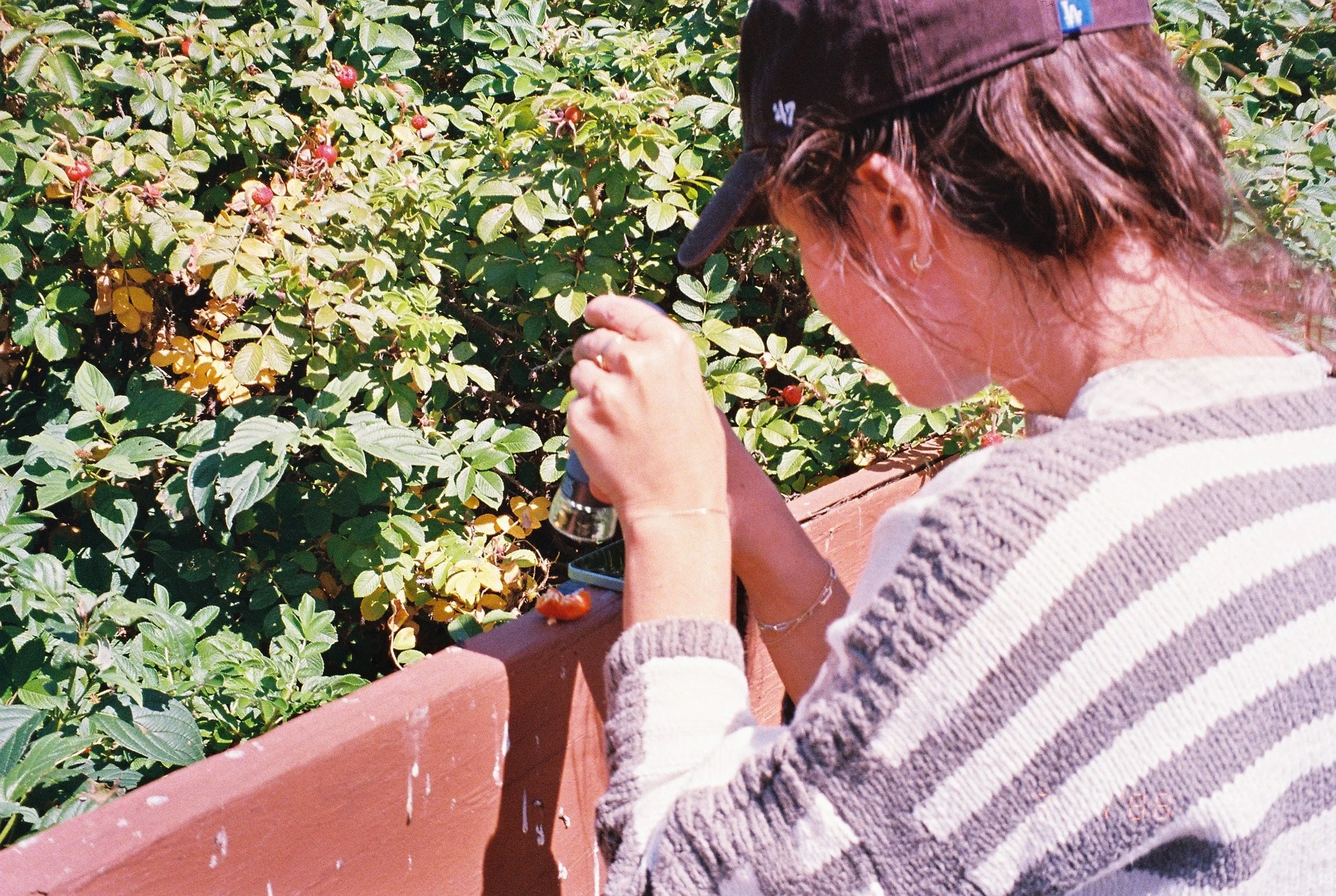
Above: Consumer-level handheld microscopes like this are designed to connect easily to a smartphone, allowing for real-time photo and video capture across scales. Credit: Marianne Couture-Cossette.
Multimodality was another integral part of the Summer Institute. In the production of collective ethnographic and art-making projects, we encouraged participants to use sound, sight, moving pictures and microscopy, alongside observation, note-taking and poetry. We outfitted them with a variety of sensing tools: consumer-level handheld microscopes enabled free zooming in and navigating scales of being, both in their deployability and ease of use. DIY hydrophones (simple piezoelectric pickups that can operate underwater, hand-built in a convenient alignment with my own graduate Research-Creation) allowed us to listen beyond the constraints of terra firma at the shoreline. Zoom handheld recorders became important for capturing stereo soundscapes and, when paired with other sound recording devices (such as shotgun mics for focused sound), provided a robust assemblage of audiovisual support for participants.
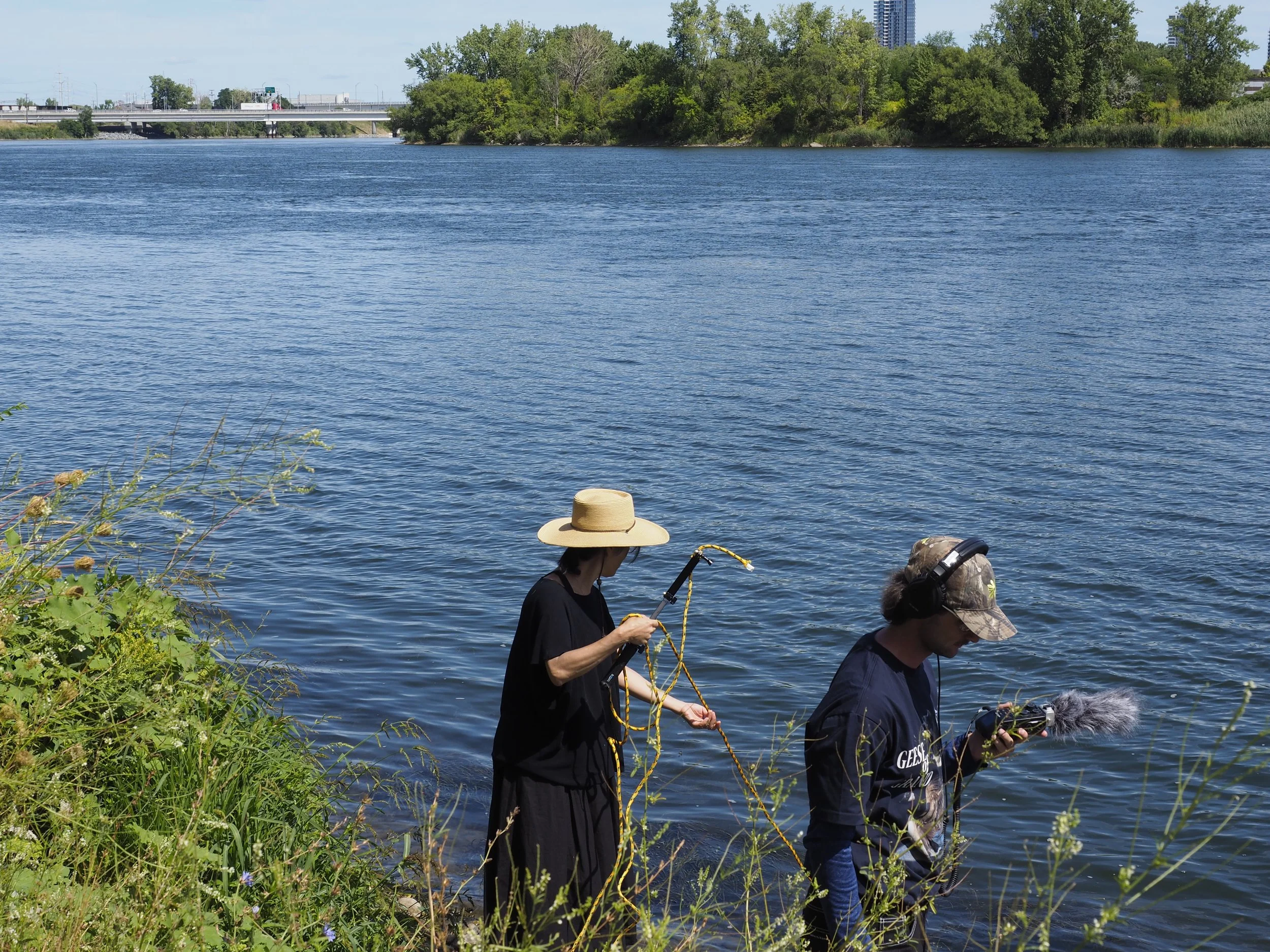
Above: Some participants immediately gravitated towards using the equipment provided, to record sights and sounds from above & below the water’s surface. Credit: Simon Parent.
Doing so, we hoped, would produce two effects: First, that sensory enhancement would elicit multiperspectival hunches about Montreal’s shorelines; Second, that the intentional over-equipping of participants with tools would prompt them to create their own sets of relations between each other and the fieldsites. Ideally, these would deepen the exploration of Verdun and Dieppe’s watery & terrestrial realms. Here, however, more moments of clunkiness, awkwardness, and difficulty were created. The possibility of all those tools inferred that they had to be used (like the Chekov’s Gun of fieldwork). This implication either resonated or conflicted with participants’ disciplinary backgrounds: while the artists were curious and eager to experiment with these tools, social scientists were largely avoidant, perhaps even intimidated. A dynamic was created between technological and textual tools as forms of engagement, and this was further demonstrated in writing and journaling workshop: Abutting the rapids at the Parc des Rapides in Lachine, the tools were put away, and individual writing exercises were instrumental in creating a moment for participants to begin unpacking the concentrated rhythms of fieldwork.
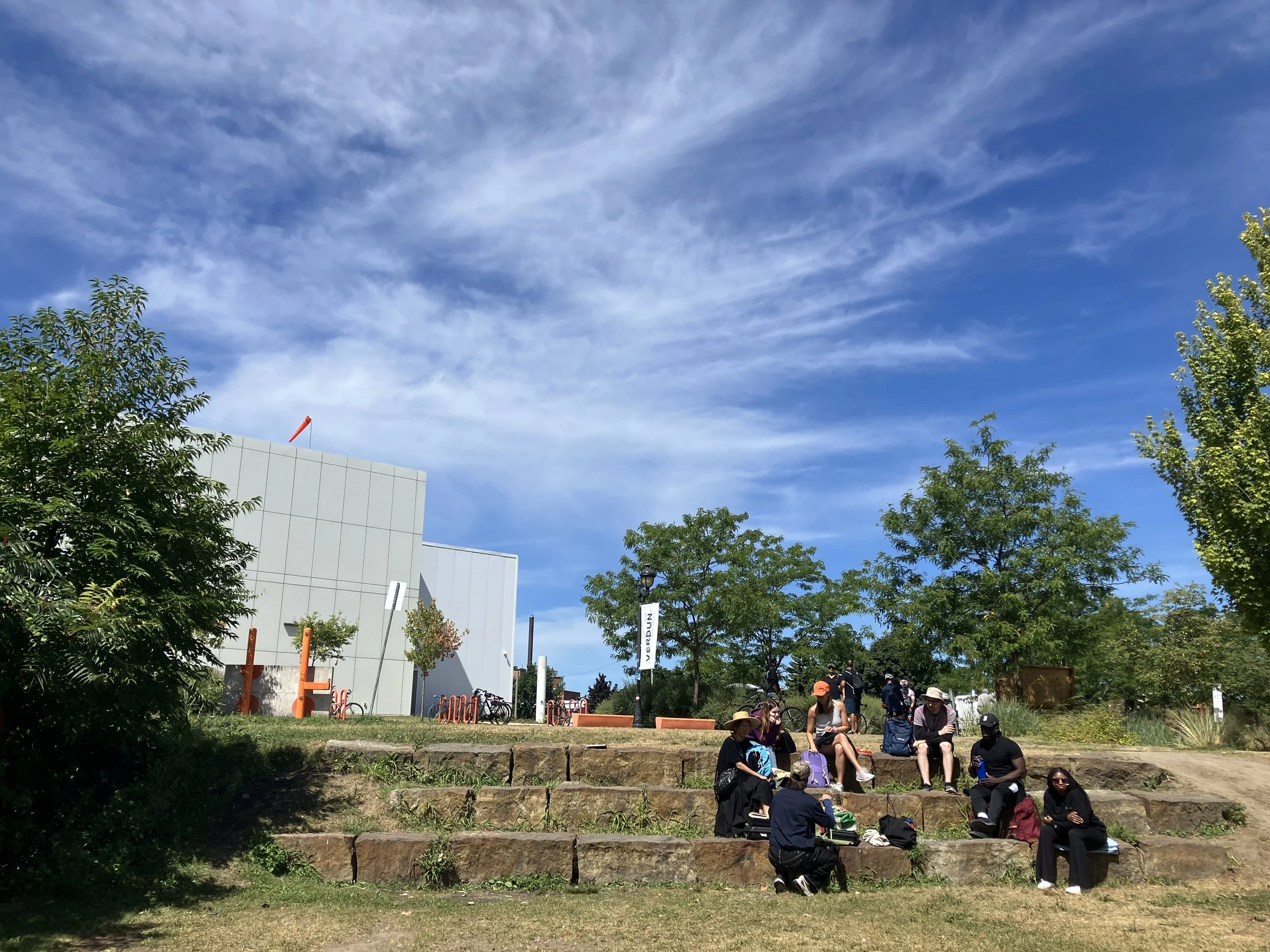
Above: Oftentimes, participants opted to rely on more traditional forms of ethnographic reflection. Credit: Patrizio McLelland.
This text might give the impression that the facilitators’ planning had overlooked the power of suggestion related to our use of technology; that we had a eureka-like moment of realisation. The truth, however, is that we had been discussing this for months before the launch of the Summer Institute. Through the iterative demonstration of sensing objects in our regular meetings, the novelty of these objects always created the symptom of overshadowing our methodological grounding. Too many ‘things’ ran the risk of obfuscating the bigger picture of collaborative ethnographic practice. One might suspect that these conversations were inherently reflective of our own biases, following our self-designation as either Artist or Anthropologist. Largely split in opinion among the facilitators, we acknowledged this dissonance, paying special attention to the shared spaces of tools and methods, putting both on equal footing in service of investigating the mess of collaborative and experimental ethnography.
And so perhaps by orienting our efforts in the Summer Institute towards being ‘in service of investigating the mess’ rather than solving, stabilizing, or organizing our understanding of the mess, we witnessed the potential contained within interdisciplinarity and the multimodality. It is exactly because collaborative experiences are so clunky, awkward, hard, that they become vital to experimental research and creation within institutions. As we face/are faced with the wicked problems of our world, anthropologists and artists are not encountering complex socio- environmental sets of relations at shorelines in a vacuum. Rather, the experiment became a way to think of shorelines as both a literal place and a microcosm of socio-cultural relations within that place. Participants were not at the Summer Institute to demonstrate what they already knew; they were there to demonstrate the uncertain process of learning something new.
Just as the handheld microscope created a set of conditions whereby one could move across scales and defy the sensorial limitations of their bodies, interdisciplinarity became a way in which we could confront and surpass the limitations of our siloed ways of thinking. Both interdisciplinarity and multimodality generated forms of inquiry in service of situatedness along the shoreline; this was perhaps the crux of the Summer Institute’s experiment. Contrary to more mediated forms of interdisciplinarity typically seen within the boundaries of the academic institution (where the fixation on outcomes can overshadow the process of inquiry), elements of the Summer Institute were clunky, awkward, hard, and, perhaps inevitably, an important meditation on the necessity of interdisciplinarity within collaborative curiosity.